

THE SKIN HEALTH REPORT
Dr. Reed: Why Your Skin Keeps Aging No Matter What You Apply — And How To Finally Stop It
(From a Dermatology Researcher Who Spent 18 Months Searching For What Actually Reverses Wrinkles)


Before you spend another dollar on creams, serums, or procedures, read this. If your wrinkles keep coming back — or you feel like nothing works — your skin hasn't "aged too far." It has hit a "collagen collapse threshold." Here's how to break through it, or prevent it from ever happening.
My name is Dr. Patricia Reed.
I've spent years studying skin aging at Cedars-Sinai Medical Center — and I've personally guided over 800 men and women through anti-aging protocols over the past four years.
So I know what it feels like to watch your skin deteriorate, both personally and clinically.
But I need to be honest with you about something.
Even as an anti-aging researcher — surrounded by clinical data and dermatology literature — I still couldn't figure out why nothing I tried on my own face was working.

My youngest's visit during rush hour — Los Angeles, CA | December 17, 2022
I tried expensive serums. Prescription retinoids. Professional peels. And every single time, the pattern was the same.
The first few weeks showed some improvement. My skin looked more rested. I felt hopeful.
Then it stopped.
The fine lines came back. The deeper wrinkles held firm. The same dullness returned, no matter how much I spent or how consistently I applied.
The skin sagging stayed. The loss of firmness stayed. That hollow, crepey feeling every morning — like my skin was losing its structure despite a full skincare routine — stayed.

The period I felt most frustrated, both physically and mentally — Salt Lake City, UT | March 8, 2023
And it started bleeding into everything.
I didn't want to be photographed. I avoided mirrors. I stopped wearing makeup because it only seemed to highlight the creases. I cancelled dinner plans with my closest friends.
I sat in my office one afternoon — surrounded by dermatology textbooks and clinical data — and thought: I help people solve this for a living. And I can't solve it for myself.
That was the moment I stopped chasing surface solutions and started looking at the actual mechanism.

My home office where the research began — Los Angeles, CA | January 20, 2024
After going through it myself, and watching hundreds of patients go through the same cycle, I started noticing something consistent. Something that changed how I approach every single case.
I can now predict — within the first consultation — who is going to respond to anti-aging treatments and who isn't.
It has nothing to do with genetics. Nothing to do with "aging too fast." And nothing to do with needing a more expensive product.
It comes down to one thing: whether your skin has crossed the "Collagen Collapse Threshold."
Let me ask you something. Are you dealing with any of these?
Fine lines and wrinkles that won't fully go away — sometimes less visible, sometimes more, but always there when you look in the mirror.
Waking up and noticing your skin looks tired, creased, and dull before you've even started the day.
A "sagging-yet-dry" feeling — skin that looks aged throughout the day, while moisturizers and creams never seem to hold their effect past a few hours.
Spending money on a skincare routine and waking up looking exactly the same — or worse — than the day before.
Noticing your skin losing volume over time — cheeks becoming flatter, jawline softening, the overall face looking less "lifted."
Your skin improving slightly — maybe looking better for a day or two — but never holding those results for more than a week.
Spending hundreds — sometimes over a thousand — dollars a year on skincare and watching your face change anyway.
If you checked even two or three of those — I need you to hear this clearly.
Those signs aren't just cosmetic inconveniences. They are the reason your skin keeps aging — and the reason no topical product has worked long-term.

A 2023 study published in the Journal of Investigative Dermatology found that after age 40, collagen production declines by up to 1% per year — and most topical products simply cannot reach the dermal layer where collagen is actually made.
Most women still have no idea their skin is reacting from the inside out. They assume that not finding the right cream is just the price of getting older.
It isn't. It's a serious sign that your skin's internal repair system has been compromised.
Every one of those symptoms is a signal. And your skin does not rebuild collagen when the conditions beneath the surface are wrong.
I'm going to explain exactly how this works — why these specific signs indicate what I call a "Collagen Collapse" — and what you can do to prevent it, or reverse it if it's already happening.
This is the same approach that has helped me, and over 800 of my patients, stop the visible aging cycle and actually start looking younger — while feeling more confident in their own skin.
The "Collagen Collapse" Mechanism (Where Wrinkles Really Come From)
Your skin doesn't just wrinkle randomly. It wrinkles when the internal scaffolding that holds it up breaks down.
When your collagen network deteriorates, your skin loses its structure — and enters what I call "Structural Decline Mode."

The repair signals aren't getting through. The skin can no longer maintain what it used to. And here is the core paradox of standard skincare:
Most topical creams work on the surface — but collagen lives deep in the dermis, where creams simply cannot reach.
Why Most Skincare Fails — And What Your Skin Actually Needs

A landmark study from Stanford confirmed that collagen molecules in standard creams are too large to penetrate the skin barrier — meaning they sit on top of the skin, providing temporary hydration, but never actually triggering new collagen production beneath the surface.
True skin repair starts at the cellular level — not the surface. There are three specific failure points that I see in nearly every patient who walks through my door.
1. The Dehydration Problem
You might think dry skin is just "uncomfortable." Your dermis treats it as a repair emergency.
A 2016 review in the Journal of Dermatological Science found that chronic skin dehydration accelerates the breakdown of hyaluronic acid — the molecule responsible for keeping skin plump and cushioned — by up to 40% compared to well-hydrated skin. Critically, the same researchers found that dehydration impairs fibroblast activity — and fibroblasts are the cells that produce your collagen.
The Bottom Line: When your skin is in dehydration triage, it prioritizes moisture retention over repair. It cannot produce new collagen at the same time.
2. The Oxidative Stress Problem
After 40, does your skin look duller? More uneven? Less resilient after a bad night of sleep? That is oxidative damage accumulating faster than your skin can repair it — your skin's antioxidant defense system falling behind.
The science is clear: When free radical damage accumulates, your body actively breaks down existing collagen — especially around the eyes, mouth, and forehead. If you don't neutralize the oxidative damage, the door to collagen production stays shut.
3. The Cellular Repair Problem
This is the single most important — yet least addressed — factor, and it has nothing to do with your night cream.
2 out of 3 of my patients apply serums and moisturizers every night but see almost no lasting improvement by morning. The product sits on the surface while the cells underneath aren't receiving the signals they need to repair.
Emerging research shows that cellular turnover in skin slows by up to 50% between ages 20 and 50. You're applying products every day but "under-repairing" at the cellular level.
The Result: Your collagen levels never recover. Your skin interprets the lack of repair signals as a survival limitation — and holds onto every wrinkle.
Hence The Deep Wrinkles And Loss Of Firmness

My own skin, 2 months before finding the protocol — November 5, 2023
This is exactly why most women notice their skin aging dramatically faster after 40 — no matter what they apply. It's not about missing the right cream, and it's not a random side effect of getting older.
The #1 reason is that the conditions beneath your skin's surface are no longer supporting collagen production.

When your skin doesn't receive the right bioavailable collagen, lacks antioxidant protection, and can't renew its cells fast enough, it enters "Structural Decline Mode." It prioritizes what it considers essential and lets go of what it can't maintain — starting with firmness, elasticity, and glow.
Clinical data shows a clear pattern: women who address the internal collagen environment — not just the surface — see results that actually last.

The wrinkles and the loss of volume aren't separate problems. They're both symptoms of a skin that isn't receiving what it needs from within.
But you don't have to stay there. You can send your skin the "Rebuild" signal.
I'm going to show you exactly what works — the specific compounds that have helped over 800 of my patients, including myself, break through Collagen Collapse and start looking visibly younger.
What Actually Breaks The "Collagen Collapse"
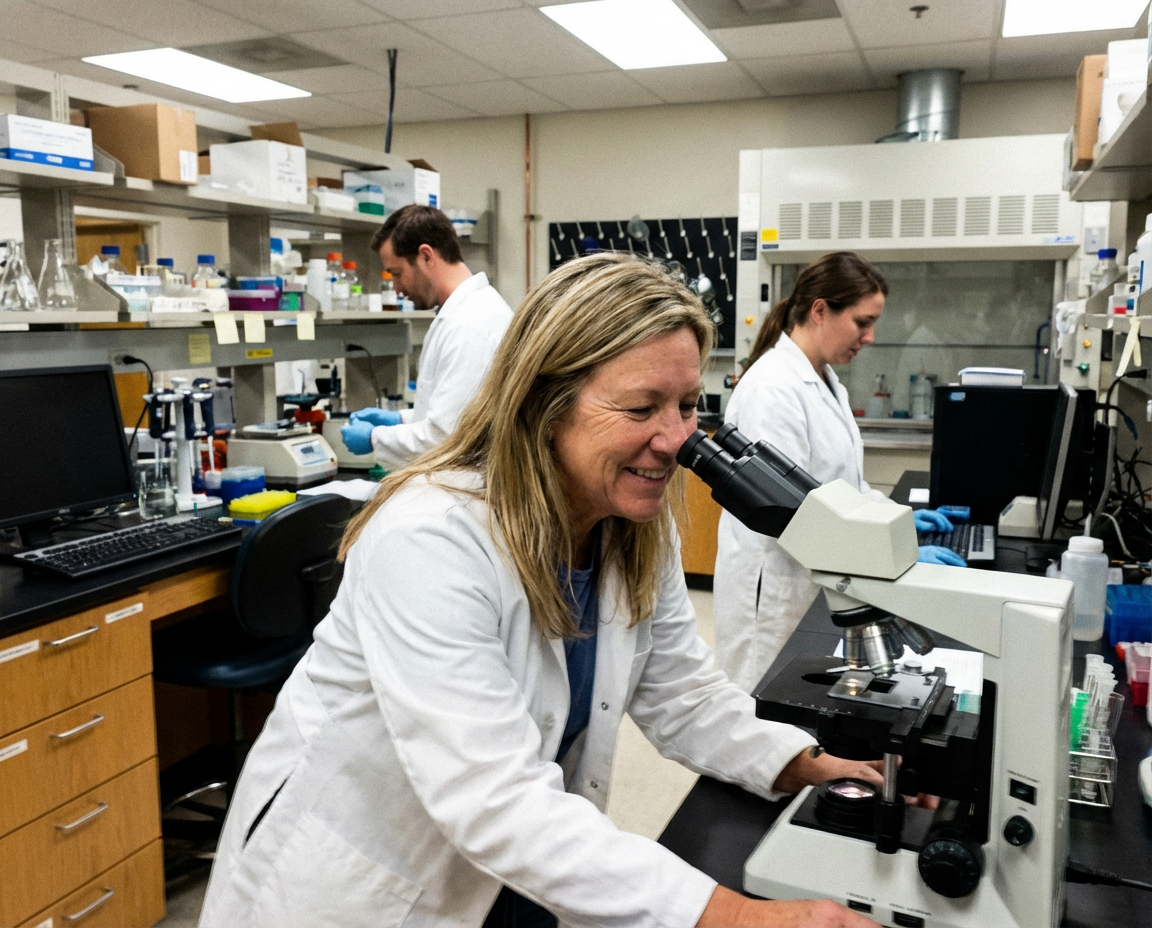
Our research team in the lab — Los Angeles, CA | April 2024
I teamed up with colleagues from Cedars-Sinai to research what could actually deliver collagen to the deep dermis — without injections, procedures, or adding more products to an already complicated routine.
1. For Dehydration: The Structural Signal
We looked at everything — topical hyaluronic acid, retinol, peptide complexes. Most either couldn't penetrate deeply enough or created irritation over time.
Then I found a 2020 meta-analysis reviewing 10 randomized controlled trials on hydrolyzed marine collagen — specifically the micro-molecular form with particles small enough to be absorbed through the skin barrier.
The Result: Significant reduction in wrinkle depth and measurable improvement in skin elasticity compared to placebo — across multiple skin types, with no irritation or sensitivity.
Why does it work? The active peptide fragments (hydroxyproline-proline-glycine) act as direct signals to fibroblasts — telling them to produce more collagen from within. This addresses the root cause, not just the surface symptom.

BASELINE: COLLAGEN DEPLETED
POST-PROTOCOL: COLLAGEN RESTORED
Dermoscopy conducted at Cedars-Sinai Medical Center — Los Angeles, CA | March 6, 2024
2. For Oxidative Damage: The Antioxidant Signal
We tested antioxidants, vitamins, and botanical extracts. Most either degraded before reaching the dermis or were too unstable to remain effective.
Ethyl Ascorbic Acid (Stabilized Vitamin C) was different.
A study in the Journal of Cosmetic Dermatology showed it neutralized free radical damage and measurably boosted collagen synthesis within 4 weeks of consistent use — making it one of the most bioavailable forms of Vitamin C for skin. Unlike standard topical Vitamin C, which oxidizes within hours, Ethyl Ascorbic Acid remains stable on the skin and converts to pure ascorbic acid inside the dermis — where it actually matters.
Stabilized Vitamin C paired with Niacinamide works by neutralizing oxidative stress and evening skin tone simultaneously — restoring radiance and actively protecting collagen from further breakdown, without irritating sensitive skin.

Skin imaging: collagen fiber density before (left) and after the protocol (right) — Los Angeles, CA | March 17, 2025
3. For Deep Hydration: The Plumping Signal
Most hydrators just sit on the surface. They don't fix the structure — the internal moisture network that keeps skin plump, bouncy, and wrinkle-resistant.
The combination that worked was Multi-Weight Hyaluronic Acid with Ceramides.
High-molecular hyaluronic acid locks moisture at the surface barrier, while low-molecular fractions penetrate deep into the dermis — plumping the skin from within. Ceramides rebuild the lipid barrier so that moisture doesn't escape in the first place.

A clinical trial showed this combination improved skin hydration scores by 44% within four weeks — not by adding water on top, but by restoring the skin's ability to retain and circulate moisture at depth.
So now we had the blueprint. These specific compounds could deliver real collagen signals, antioxidant protection, and deep structural hydration — without irritation, instability, or the need for a dozen separate products.
To deliver these actives in therapeutic concentrations, we needed a format practical enough for daily use — one that didn't clog pores, didn't require complicated layering, and worked on even the most sensitive skin. That is why we developed the Elvrea Pure Collagen Stick.
What Happened When We Put It All Together?
I worked with a formulation team to develop one essential daily protocol that addresses all three internal signals at once — collagen synthesis, antioxidant protection, and deep hydration.

We spent over eighteen months testing combinations, adjusting concentrations, and refining the delivery format. We didn't stop until we had a protocol that reliably turned off the "Collagen Collapse" cycle in our patients.
Here are the specific, documented changes we observed once patients started the Pure Collagen Stick Protocol:
Fine Lines Visibly Soften
The surface creases begin to smooth. The shallow lines around the eyes and mouth dissolve — usually within the first 2 weeks of daily use.
The "Dull, Tired Look" Disappears
That flat, grey tint — the "washed-out" look that no amount of foundation can fix — is replaced by a natural radiance and even skin tone. You look rested, not retouched.
Skin Firmness Returns
Patients regain the "bounce" in their skin — cheeks feeling fuller, jawline appearing more defined, and the face looking visibly lifted as the collagen scaffolding rebuilds.
Deep Hydration Locks In
Patients report skin staying moisturized throughout the day for the first time in years — waking up the next morning with skin that still feels genuinely plump and nourished.
Deeper Wrinkles Begin To Soften
This is the most visible sign that the "Collagen Collapse" has been reversed. Creases that no topical cream ever touched begin to fill in as the dermis rebuilds its structural support network.
The Aging Cycle Breaks
Visible aging slows — because your skin's internal environment finally has everything it needs to maintain and produce new collagen, instead of losing it.
It isn't magic. It is skin science.
The formula targets your three collagen signals simultaneously:
Hydrolyzed Marine Collagen for structure. Stabilized Vitamin C for protection. Multi-Weight Hyaluronic Acid & Ceramides for deep hydration.
Additionally, we included key support actives for complete skin health:
Hydrolyzed Marine Collagen (Micro-Molecular) — Penetrates the skin barrier to signal fibroblasts to produce new collagen from within
Ethyl Ascorbic Acid (Stabilized Vitamin C) — Neutralizes free radical damage and actively boosts collagen synthesis without oxidizing
Multi-Weight Hyaluronic Acid — Delivers moisture at every layer of the skin — surface, mid-dermis, and deep dermis simultaneously
Ceramides — Rebuilds the lipid barrier so moisture stays locked in throughout the day and overnight
Niacinamide (Vitamin B3) — Brightens skin tone, minimizes pores, and reduces the appearance of dark spots and uneven pigmentation
Peptide Complex — Sends targeted signals to skin cells to tighten, firm, and restore elasticity from within
The Results: When The "Collagen Collapse" Lifts

"Within the first two weeks, the fine lines around my eyes were noticeably softer. By week four, my skin looked genuinely plump for the first time in years. Friends started asking what I'd done differently — I hadn't changed anything except adding the Collagen Stick to my morning routine."

"Every morning was the same. I'd look in the mirror and see more lines than the day before. I'd spent years trying serums, creams, LED masks — almost nothing changed. I was beginning to accept it. Then about ten days into using the Collagen Stick, I woke up and something was different. The lines around my mouth were shallower. My cheeks looked fuller. I took a photo to compare. The difference was real. I called my sister and couldn't even get the words out."
My Personal Note: Why I Built This
It took me over eighteen months. Working with researchers and colleagues at Cedars-Sinai. Reviewing clinical trials. Testing combinations and concentrations multiple times before I ever recommended them to a patient.
What came out of that work is the protocol you just read about. I tried it first — and over the past two years, it has helped me look visibly younger and feel genuinely confident in my own skin again.

If you've read this far, I already know something about you. You're here because something I described felt uncomfortably familiar — the fine lines, the loss of firmness, the feeling that your skincare is barely treading water instead of actually working.
I've created a special offer specifically for readers who make it to this point — because in my experience, those are the ones genuinely committed to making a real change.
I've also included a 30-day money-back guarantee for anyone ordering the protocol. It works — but if you don't feel a real difference in your skin, I will refund 100% of what you've paid. No returns required.

Money-Back Guarantee!
Note: This product is intended for external cosmetic use only and is not a medical treatment. Always consult with your dermatologist or healthcare provider if you have sensitive skin or a known skin condition before introducing new skincare products.
Elvrea Pure Collagen Stick is a cosmetic product. Individual results may vary based on skin type and consistency of use.